

Stop Calling Murderers Loners
A 21 year old man shot and killed 10 people in a spree at his former high school in Austria.

If there’s one thing that I would consider myself an expert on at this point, it’s mentally disturbed men. Is this concerning? Probably, but it offers a unique insight into what I believe is an increasingly fatalistic notion that results in harm to themselves and the surrounding environment.
Earlier this week, the news broke about a school shooting in Graz, Austria. It seemed to really strike the world, mostly because you never really hear about school shootings in anywhere but the United States. He killed 10 people at a high school he formerly attended, but never graduated.
There’s haunting scenes of gunshots and screaming children that are all too familiar to us. The man turned the gun on himself when the authorities arrived, mere minutes after the shots were reported. 10 people, in under seven minutes. Most of whom were under the age of 18.
While this is a tragedy, humans tend to want a logical explanation. Why? Why would someone do this, how could they do this, and what put them in the position to do this? It’s a control mechanism to try and center yourself in an unfamiliar situation. It’s what everyone does when they’re faced with an unconceivable crime. Try to rationalize it. As the days go by, naturally more details come out surrounding the attack, the victims and the shooter.
The New York Times is particularly talented at this, and I often turn to their pieces because of the structural order they offer — background, situational context, etc. It’s as much journalism as it is telling a story. However, I am quite critical of how news outlets chose to cover this sort of violence, particularly with mentally troubled men.
Elliot Rodger is considered by many people to be the “first incel.” He’s the first incel who went public with his beliefs, publishing a manifesto and extensive video diaries about his hatred for women and social issues. Rodger killed six people and injured more, before killing himself. This is what I like to call the ‘after piece.’ A few days after the violence, with as much context as gotten, and a narrative tone. This happens regularly after a major crime, and now that I’ve pointed this out you won’t be able to unsee it. Sorry.
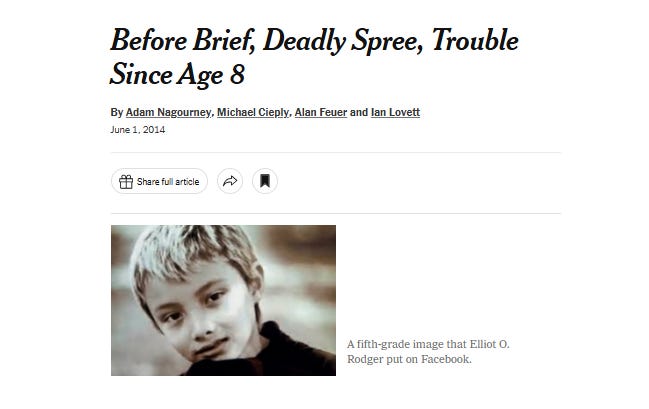
This piece was published 9 days after Rodger’s attack. It describes him as withdrawn. He had emotional problems, there’s a photo of him as a child. They write of years of withdrawal, puzzling psychological problems, panic attacks, schoolyard bullying, things of this nature. But not one person quoted in the piece says that they are surprised. Try to separate yourself from Rodger as we are with the Austria shooter. We don’t know that much about him, we barely know that much about the shooting itself. When you read this article, you are given an image of a troubled young boy struggling with his place in the world. He was practically set up to fail, you might say. He was unmedicated, his parents were going through a nasty divorce. Sure he said some weird things to his friends or some girls, but that wasn’t cause to speak to the authorities. It’s not that serious.
It’s precisely this sort of narrative that is getting women killed, every day. One in twelve women in the U.K. are victims of gender based violence, amounting to 2 million women a year. The NPCC report estimates 3,000 offenses a day against women and girls over the age of 16. The average age of victims of gendered child abuse is 13, with the average age of perpetrators being 15. It is a 300% increase over 10 years. One in every three women across the globe has experienced sexual or physical violence at least once in their lives. Fifty-eight percent of adolescent girls and young women have experienced some type of online harassment — and most report their first experience to be between the ages of 14 and 16.
It is very much so, that serious. The Austrian attack is evident enough.
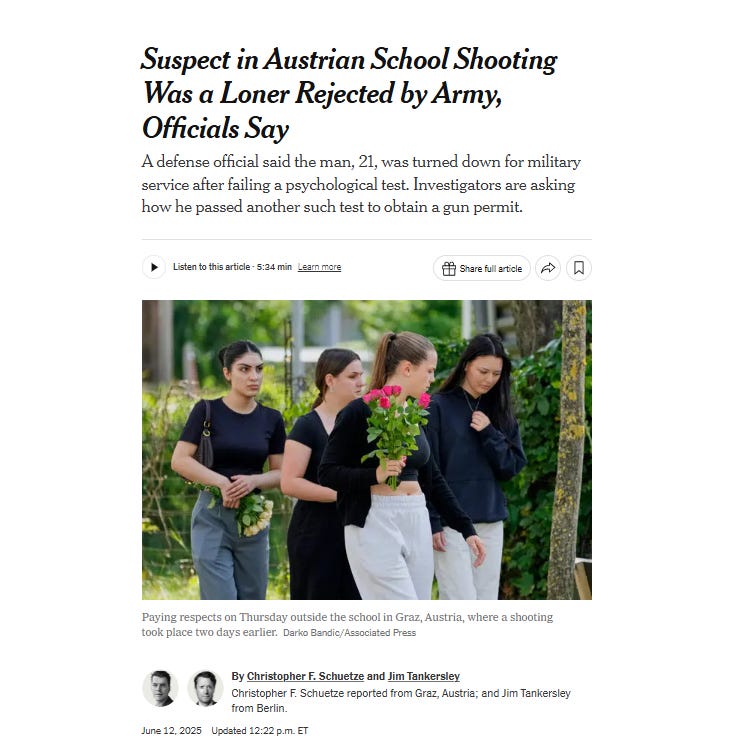
The headline of this piece originally caught my eye because they describe a man who murdered ten people a loner. We have 20/20 hindsight looking back at the man’s habits and hobbies now, and I know that — but there are always signs, and I will always advocate that getting psychological help will never, ever hurt someone. But not getting it can and will hurt them or others.
Officials told The New York Times that he was “a loner obsessed with online shooting games who failed a psychological test to enter the army.” A spokesman for Austria’s Defense Department told them he failed the test for military service, but passed the test to obtain a gun. (Austria, unlike the U.S., has a mandated psychological exam required for owning a gun). At the news briefing, the police said he lived “an extremely reclusive life and was unwilling to participate in normal activities outside the real world.” They said he was devoted to first-person shooter games specifically.
His apartment contained a pipe bomb and detailed plans for the attack. On his person, a handgun and sawed off shotgun, significant amount of ammunition, sports goggles, headset and hunting knife.
When you put all this information together, it seems painfully obvious. It seems inevitable in Austria, let alone in the U.S..
To their credit, the Austrian police showed up within 6 minutes and immediately entered the school. Within 8, over 50 officers equivalent to SWAT were surrounding the building. The national director of that team said “we must equip all officers to be able to go in” on TV — harking back to the 2018 Parkland shooting or even Uvalde, when deputies waited outside the school for several minutes.
I say all of this to bring a wider attention to the severe issue that is mass shootings, particularly brought about by those who are men. Calling them loners and emotionally complex may be true, but it diminishes the level of unconscious responsibility the public places on their shoulders. Think of it when a man kills his wife after an argument over her cheating. Some people will place part of the blame on her for cheating — despite her being the one murdered.
Women are in danger every day. Domestic violence is a leading cause of injury to women. Around the world, an estimated 27% of women who have been in a relationship report having experienced some form of physical or sexual violence by their intimate partner. Men aren’t allowed alone in a room with women unconscious in comas. Hospitals keep them on birth control for that reason.
57 women are shot and killed by an intimate partner each month.
And I would bet money, that each of those men seemed a little off at times. A little too into Call of Duty, maybe.
Preventative measures need to be taken, if not for women than for the future of these young men. They need HELP. They need psychological medication and assistance. Most importantly, they do not need equipment for mass murder. And the language on these pieces and this coverage is incredibly important. Because the next man who will do this, he is watching. He is reading, listening, paying obsessively close attention to the details and the reaction. He is noting how his friends react, his family, and how society treats the memory of the killer.